
Guardian Angel Day Care Center
The History of the One of the Sisters' Longest Ministries
The Franciscan Sisters of Chicago have been involved in many ministries over the years from elder care to education. One of these first ministries was childcare. Beginning with the establishment of St. Vincent’s Orphan Asylum in 1899, the Sisters would operate St. Elizabeth's Day Nursery from 1904 to 1915 and then again from 1920 to 1959. There would be much success in these endeavors, so much so that it would lead to another childcare facility in just a few years. This facility, Guardian Angel Day Care Center, would become one of the places where the Sisters would serve the longest.

Guardian Angel Day Nursery and Home for Working Girls (the facility's Original Name) in Chicago.
The idea for Guardian Angel Day Care Center began with the Reverend Louis Grudzinski, the pastor of St. John of God Church, a large parish with over 2400 families in Chicago. Fr. Grudzinski was moved by the plight of the Polish and other immigrants who had settled in the area near his parish located in the “Back of the Yards,” the area close to the world-famous Union Stock Yards. With the help of the Reverend Stanislaus Cholewinski and the Reverend Francis Karabasz, he developed Guardian Angel using the famous Hull House (founded by the famous philanthropist Jane Addams) as a model.
The facility opened in 1912 and was called Guardian Angel Day Nursery and Home for Working Girls. It was split into four sections: a child daycare center, a shelter for Polish immigrant women who worked in “Packingtown,” an assembly hall for events, and a health clinic and dispensary. The assembly hall served as a place for banquets, arts and crafts sessions, and even English and naturalization classes for recent immigrants. The health clinic, which was ahead of its time, provided medical care for free or discounted rates for the needy. By 1915, there was a need for bigger accommodations, so the priests purchased land at the junction of 46th Street and Gross Avenue (now named McDowell Avenue after Mary McDowell, the famous Chicago social reformer) and built a large building there. Originally the Sisters of the Congregation of St. Felix of Cantalice (Felicians) were staffing the center, but by 1917, Father Grudzinski decided to change course. He appealed to Mother M. Aloysia Holyz, General Minister of the Franciscan Sisters of Chicago, for help to have their Sisters staff the facility. He was aware of the Sisters' past success with St. Vincent's Orphan Asylum and St. Elizabeth’s Day Nursery so he felt it would be a perfect fit. Mother Aloysia agreed to his request and later in the fall of 1917, the Franciscan Sisters of Chicago took over as administrators at the daycare center. Sr. M Ladislaus Wroblewski served as the first superior and was placed in charge of running the institution. Soon other Sisters and postulants joined and helped in the many duties of the day.

Sisters with the children at lunch in 1944.

Sr. M Ladislaus Wroblewski

An operating room in the health clinic.
Once they took over, the Sisters were very successful in developing a routine schedule for the children as they organized the sleep, play, school, and mealtime. The nursery was located on the second floor. Originally, they cared for children as young as newborns but eventually set the age limit to children from 2 to 7 years of age. They also would often stay late to care for the children of parents who had to work overtime at the stockyards. On the third floor were the dormitories that housed all the working women. The Sisters created a family atmosphere and provided meals and other amenities for the women. They also never turned down any applicants if they were unable to pay. The health clinic, located in the basement, became well known throughout Chicago. There was an X-ray room, operating room, pharmacy, and consultation rooms. It was very modern for the time. All patients were accepted no matter their race or ethnic background. Neighborhood physicians, optometrists, and pharmacists volunteered their time at the clinic. The Sisters were applauded by the doctors for managing the dispensary so well and also for maintaining a high level of sanitation and cleanliness in the clinic. Sr. M. Ladislaus especially was commended for all her work. When she was assigned to work in the infirmary at the Motherhouse in Lemont, Fr. Gruzinksi made an appeal for her return, citing that he needed her for her high level of professionalism. She would eventually return for a year but later would go on to be the first superintendent at St. Joseph Home for the Aged and Crippled in Chicago.
There were many challenges over the years, especially in the beginning. When the Sisters took over in 1917, the Spanish Flu epidemic was spreading. Other diseases like tuberculosis were also prevalent in the city as it was one of the highest causes of death in Chicago at the time. The Sisters braved the dangers and treated the sick and afflicted, even going to their homes and staying to care for them. An estimated 5,000 people were treated at the clinic during the epidemic. Two Sisters sadly lost their lives to tuberculosis in 1919 as they risked their lives to help others who were suffering from it. By 1928, 20 infants and 85 children were cared for daily. Nearly 40 women lived in the dormitories and over 1500 people received medical treatment annually. In the summer, when school was out, the Sisters took care of over 150 children daily. It was an enormous undertaking as they worked incredibly hard to make sure each child was cared for.
At the height of the Great Depression (1931-32), the Sisters cared for over 800 children annually and only charged 15 cents a day for families. Some families even received childcare free of charge if they couldn’t pay the fees. This also applied to the working women living in the dormitories as many of them were allowed to stay for free for periods at a time. The Sisters tried to accommodate all those who struggled economically during the depression. During World War II, even with a shortage of Sisters at Guardian Angel, they continued to care for many children of women who worked in the factories and defense plants. These working women took on long hours to help with the war effort; thus the Sisters extended their hours resulting in long days for the Sisters.

Sr. M. Ludmilla Fedak with children at Guardian Angel
in the 1950s.

Sisters with children in the kindergarten class.
Even though Fr. Gruzinski and the other two pastors were founders and the owners of Guardian Angel, they became less involved with the overall operations of the facility. As time went on, they had other commitments to their parishes, as well as their own advancement in age. Thus, the Sisters not only took on the role of staffing and management, but also finances, often covering the debts and costs that were incurred. To keep the operational costs affordable, donations were often accepted from Catholic Charities, and various churches from the Back of the Yards.

Sr. M. Dosithea Ruz
Sr. M. Dosithea Ruz often helped raise funds to cover food and other costs. Over the years, the Sisters would petition the priests and ask for ownership of Guardian Angel. It would take time for this to happen but eventually it did. When Fr. Gruzinski passed away in 1948, ownership of Guardian Angel transferred to the Sisters in 1952. Later that year, with the rise of various health clinics and the services offered in the city of Chicago, the health clinic began to cut back on staff and services. Eventually it would close by the end of 1952. It is estimated that nearly 25,000 people received free health care and an incalculable number of people received affordable care over the 35 years that it was open. The clinic was later converted into more rooms for the working
women.
The main building underwent changes over the years. By 1934, the assembly hall was used for various classes for people and had terminated its social functions. The Sisters found that maintaining the hall after weddings and dances was too difficult. Thus, a chapel was created in 1949 out of the old assembly hall. The Sisters finally had a suitable chapel where they could visit and pray while they took breaks from work. Others could pray there as well. Another addition was a playground that was created on the roof which was complete with a floor, fencing, and screening around the top. Eventually two lots across the street were donated to the Sisters to be used as a future playground. Two more lots were purchased in 1956 and eventually the entire area was turned into a playground. Statues of Our Lady of Fatima and another of St. Joseph were donated and placed within a grotto for outdoor prayer and to add beauty to the area. The children and the Sisters loved their new outdoor area. More changes came over the years.

The chapel at Guardian Angel.

Santa visits the children at Guardian Angel.

An overhead photo of the back of Guardian Angel
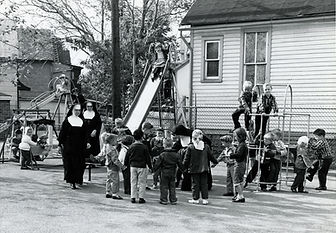
The playground at Guardian Angel.
In 1973, the name was changed to Guardian Angel Day Care Center and Home for Ladies. As more children were admitted into the daycare, the Sisters opened up a third classroom for preschool. The facility continued to be known throughout the area for its quality childcare. By 1983, the Sisters started to phase out the dormitories for the working women. With the changing times, as well as the rising costs of maintenance, the Sisters felt they would serve the area better by focusing just on childcare. Thus, these rooms were renovated and converted into a kindergarten. Within the next few years, with the rising costs and fewer Sisters to help manage the center, the Sisters decided to close Guardian Angel Day Care Center in 1991, after serving there a total of 74 years. So many people who grew up in the Back of the Yards have wonderful memories of their time at the center. Guardian Angel Day Care was the living embodiment of Mother Mary Theresa Dudzik’s vision of caring for others in the world.

A Sister feeds the children breakfast (1940s).

(Left to Right) Sr. M. Mildred Bieda, Sr. M.
Bernadette Bajuscik, Sr. M. Edna Perciach, Sr.M. Dosithea Ruz, Sr. M.Vincent Swies, Sr.M Rose Ann Zmich

Sr. M. Vincent Swies plays guitar for the children.